Power Bank Comparison
Anker 25K 165W vs Anker Prime 26K 300W: Which Is Worth It?
The recorded weight is nearly identical. What does the extra money for the Prime actually buy?
This comparison contains paid links. We may earn a commission at no extra cost to you. Affiliate disclosure.
Quick Verdict
For most students, start with the Anker 25K: it offers up to 100W through one USB-C charging path and includes built-in cables. The Prime earns consideration when its up-to-140W single-port output, greater simultaneous output, conditional faster recharge, or app controls solve a real need. Neither headline total is power sent to one laptop.
Buy the 25K if…

Most students · built-in cables
Anker 25K 165W
Choose this for an everyday USB-C laptop and a simpler campus bag, provided its single-port output meets your verified laptop needs.
- 25,000mAh · 90Wh
- Up to 100W from one USB-C path
- 2 built-in USB-C cables
(paid link)
Buy the Prime if…
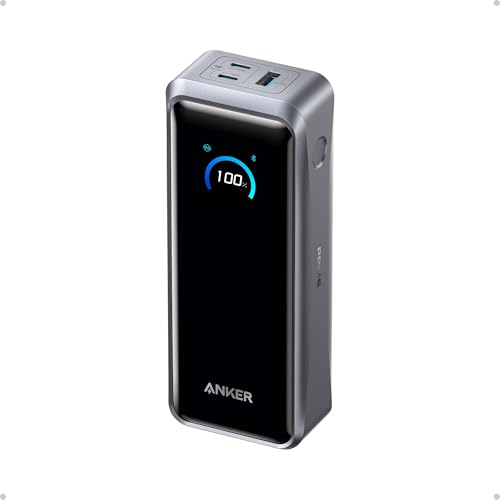
Higher-power laptop · several devices
Anker Prime 26K 300W
Consider the Prime when a verified laptop can use more USB-C power, you regularly share high output, or its supported fast recharge and app controls matter.
- 26,250mAh · 99.75Wh
- Up to 140W from one USB-C port
- Up to 300W combined
(paid link)
Quick decision tool
Which one should you buy?
Question 1 of 6
Does your laptop have a verified USB-C charging need above 100W?
Use the exact laptop model and USB-C charging specification, not only its AC-adapter rating.
Anker 25K vs Prime 26K at a glance
| Specification | Anker 25K | Anker Prime 26K |
|---|---|---|
| Capacity | 25,000mAh · 90Wh | 26,250mAh · 99.75Wh |
| Maximum combined output | 165W with two devices; 130W with three or four | 300W across three outputs |
| Maximum single USB-C output | 100W | 140W |
| Cables and ports | 2 built-in USB-C cables + 1 USB-C socket + 1 USB-A socket | 2 USB-C sockets + 1 USB-A socket; no built-in cable documented |
| Recharge input | Up to 100W USB-C; peak above 25% battery level | Up to 140W standard USB-C; 150W Anker Protocol; 250W dual-input with compatible equipment |
| Weight and dimensions | 595g · 157 × 54 × 49 mm | 600g · 159.9 × 38 × 62.7 mm |
| App controls | Not established in source record | AnkerSense via Bluetooth |
165W vs 300W: what those numbers really mean
Anker lists 165W maximum combined output for the 25K when two devices are connected, falling to a 130W maximum for three or four devices. The Prime’s 300W is a combined maximum across its outputs. Those figures describe power sharing, not the output available to one laptop.
For one USB-C device, the documented maximums are 100W and 140W respectively. Actual delivery depends on the laptop, cable, protocol, state of charge, and the other devices attached.
Single-device laptop charging
Both banks offer more than many everyday laptops need. Only treat the Prime’s extra single-port headroom as a buying reason if your exact laptop is verified to accept more than 100W through USB-C. A large supplied AC-adapter rating alone does not prove that.
Not sure? Check your laptop model and USB-C charging requirements. Our 65W vs 100W guide explains the common lower-output decision.
Multi-device charging
The 25K can serve up to four devices through its two cables and two sockets, but Anker specifies a 130W maximum when three or four are connected. The Prime offers 300W maximum combined output across two USB-C and one USB-A socket. The greater total is useful only when your connected devices can draw that power together.
These are manufacturer maximums, not simultaneous-output measurements by SWG. Check Anker’s port-combination details for your intended setup.
Built-in cables and campus convenience
The 25K includes 2 built-in USB-C cables, a separate USB-C socket, and a USB-A socket. That is the clearest daily convenience difference for a student moving between classes, libraries, and shared workspaces.
The Prime has 2 USB-C sockets and 1 USB-A socket; Anker does not document built-in cables for it. Bring compatible cables, especially when aiming for its highest output or recharge input.
Capacity: close in mAh, different in Wh
Anker rates the 25K at 25,000mAh / 90Wh and the Prime at 26,250mAh / 99.75Wh. The Prime has 9.75Wh more stated energy, but neither figure guarantees a number of laptop hours. SWG has not measured usable energy or runtime.
For U.S. flights, the FAA says power banks belong in carry-on baggage only and generally limits lithium-ion batteries to 100Wh. Both manufacturer ratings are under that threshold; check the physical label and your airline’s current rules, especially for the Prime near the limit.
Recharge speed and the equipment it requires
Anker lists up to 100W USB-C input for the 25K, with peak input only above 25% battery level. The Prime lists up to 140W standard USB-C input, 150W with Anker Protocol, and 250W using both USB-C inputs under specified conditions.
Anker says the Prime can reach 50% recharge in 13 minutes in its internal tests. Its 250W setup requires two compatible chargers and 5A cables; the result is not an SWG measurement or a promise with an ordinary single charger.
Portability: almost the same weight, different shape
Anker lists 595g and 157 × 54 × 49 mm for the 25K, versus 600g and 159.9 × 38 × 62.7 mm for the Prime. The 5g stated weight difference is small; their shapes and cable arrangements may matter more in a packed bag. SWG has not weighed or carried either bank.
App and smart features
Both products have displays. Anker documents AnkerSense app controls, Bluetooth connection, charging status, and adjustable power distribution for the Prime. The current manufacturer record does not establish equivalent app support for the 25K; do not assume it from the display alone.
Which one fits your student setup?
Everyday classes and study
The 25K is the starting point when its USB-C output meets your verified laptop need and built-in cables reduce what you pack.
Demanding or shared setups
Consider the Prime if your verified laptop can use its extra single-port output, several devices share high power, or its conditional fast recharge and app controls matter.
For more alternatives, see Best Laptop Power Banks for College Students and use the compatibility checker before buying.
Final Verdict
For most students, the Anker 25K is the more practical default. The Prime’s premium makes sense for a verified higher-power laptop or a genuine multi-device, fast-recharge, or app-control need. Compare the capability you will use, rather than assuming the larger combined-output number is automatically better.
FAQ
Does 300W mean 300W to one laptop?
No. Anker lists up to 140W from one Prime USB-C port. The 300W headline is a total across outputs.
Are the capacity and weight effectively identical?
The stated weights differ by 5g, but rated energy differs by 9.75Wh. Both figures come from Anker, not SWG testing.
Do I need a special setup for 250W Prime recharging?
Yes. Anker specifies both USB-C inputs, suitable 5A cables, and compatible high-power chargers for its 250W maximum.
Can I fly with either power bank?
Their rated energy is below the FAA’s general 100Wh limit, and power banks must travel in carry-on baggage. Verify the label and your airline’s rules before travel.
Has SWG tested these power banks?
No. This is a research-based comparison of manufacturer documents and stated specifications. We have not measured charging, runtime, or portability.